The AI Didn’t Hallucinate. It Told the Truth. That Was the Problem.
A technically solid LLM email pipeline — 10,000 emails, 36 classification buckets, six N8N workflows — reproduced institutional confusion at scale and called it procedures. This is what Knowledge State Failure looks like, and why no model upgrade fixes it.
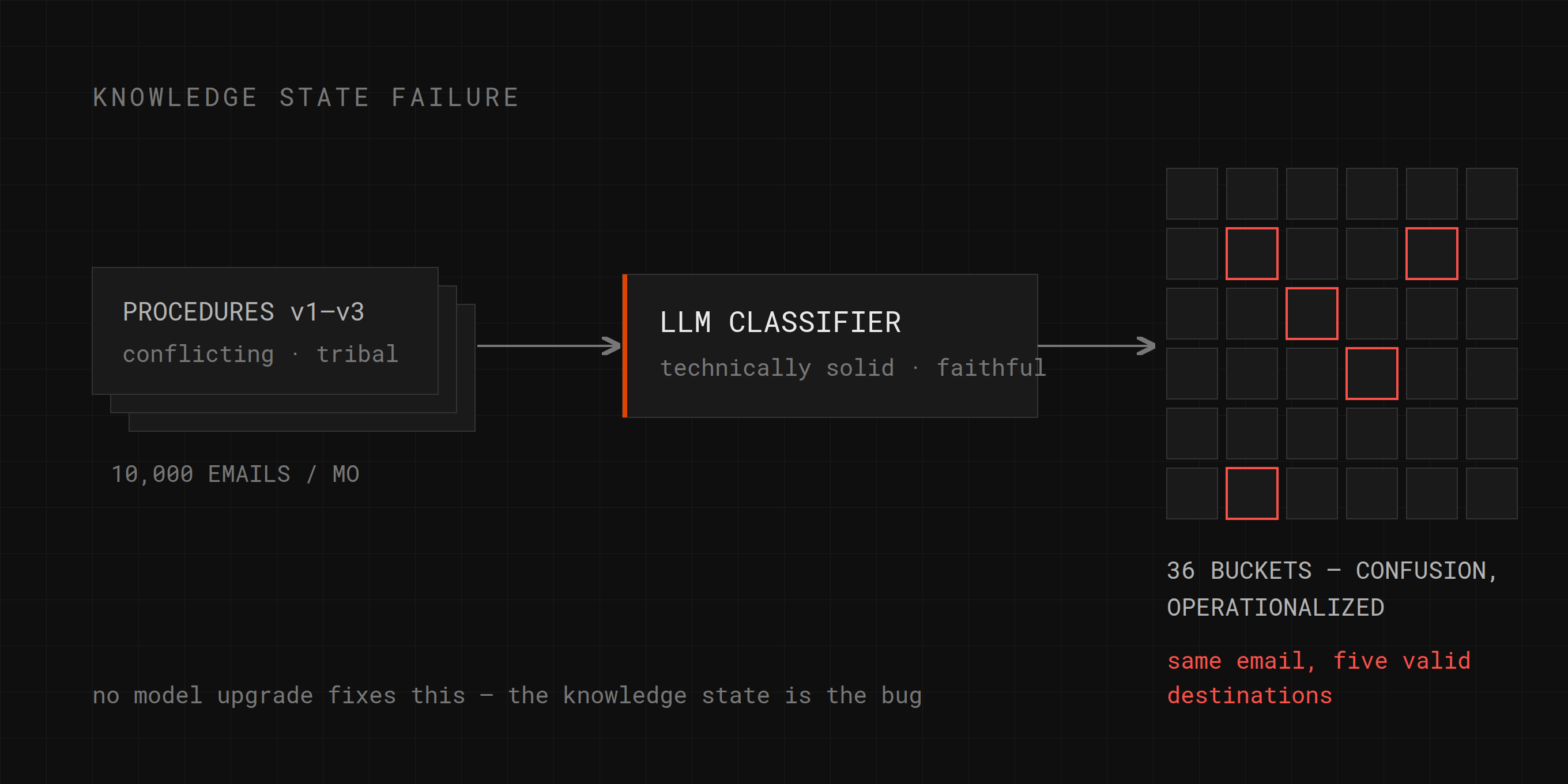
The boss looked at a month of my work and said, "That's shit."
He wasn't wrong. Not because the system was broken — because it worked exactly as designed. And what it faithfully reproduced was four thousand units of institutionalized guesswork.
This is a Knowledge State Failure. AI doesn't create organizational chaos — it amplifies whatever state already exists and formats it to look professional. If your processes live in people's heads, your AI will faithfully systematize that confusion at scale. Fix the knowledge architecture before you build the AI.
What I Actually Built
Most LLM production failures get blamed on the model. This one had nothing to do with the model. The pipeline processed 10,000 emails, classified them into 36 distinct buckets, and generated trained SOPs per category across six N8N workflows. It worked exactly as intended. The failure predated the first line of code.
I was brought in as the AI person at a 4,000-unit property rental company. Six weeks learning the business before getting the real brief: build an AI email auto-responder. Email volume was high, response quality was inconsistent. The automation value was obvious.
What I found: no SOPs. Everything in people's heads. Four thousand units of operational complexity encoded purely in institutional memory.
I built it anyway. Here's what the classification system looked like:
{
  "categories": {
    "maintenance": {
      "subcategories": ["emergency_repair", "routine_maintenance", "tenant_request", "vendor_coordination", "warranty_claim", "inspection_follow_up"]
    },
    "leasing": {
      "subcategories": ["showing_request", "application_inquiry", "lease_renewal", "early_termination", "transfer_request", "pricing_question"]
    },
    "payments": {
      "subcategories": ["late_payment", "payment_dispute", "nsf_check", "security_deposit", "fee_inquiry", "refund_request"]
    },
    "complaints": {
      "subcategories": ["noise_complaint", "neighbor_dispute", "management_complaint", "amenity_issue", "pest_report", "safety_concern"]
    },
    "move": {
      "subcategories": ["move_in_coordination", "move_out_notice", "key_handoff", "unit_condition", "forwarding_address", "damage_assessment"]
    },
    "general": {
      "subcategories": ["information_request", "document_request", "policy_question", "emergency_contact", "community_event", "unclassified"]
    }
  }
}
Six categories. Six subcategories each. Thirty-six classification buckets. For each bucket: an SOP trained from the email corpus, loaded by an N8N intent-detection workflow, fed into a draft auto-response generator. Six separate workflows just for SOP generation. One for the responder.
This was not a naive prototype.
Why Did It Fail Before It Launched?
The AI reproduced the email corpus with precision. What was in the corpus was four thousand units of unexamined institutional knowledge — procedures nobody had ever written down, passed through layers of management that had never been asked to explain their reasoning. Clean formatting made it look authoritative. That made it more dangerous than raw confusion.
I showed the boss the output. He looked at the generated responses and said: "That's shit — my employees and managers don't even know what they're talking about."
He wasn't blaming the AI. He was recognizing the organization.
The system worked as a mirror. It reflected back exactly what the company knew about its own operations. Undocumented assumptions. Inconsistent procedures. Institutional improvisation that had never needed to be written down.
"I have about a year's worth of work to do before I can use a guy like you."
That's the most honest systems diagnosis I've heard from a non-technical operator. He understood immediately that the problem wasn't the AI — it was the state the AI was trying to operate on.
What Is Knowledge State Failure?
Knowledge State Failure occurs when an AI system faithfully reproduces unstructured organizational knowledge at scale, producing confident, formatted outputs that institutionalize confusion rather than surfacing it. The danger isn't hallucination — it's authority. Clean output looks decided. Decided things stop getting questioned.
This failure mode lands at two STATE pillars simultaneously.
Structured: The AI needs something to run on. If that something is 10,000 emails encoding undocumented decisions, the AI encodes the undocumented decisions. The structure of the input determines the structure of the output. Tribal knowledge is not a data quality problem — it's a state architecture problem.
Explicit: There's no validation gate on the knowledge layer itself. The system had no mechanism to flag "this SOP was derived from contradictory email patterns." It generated clean procedures from messy evidence. Explicit state means surfacing that conflict, not papering over it.
No model upgrade fixes this. Not a temperature problem. Not a prompt engineering problem. The organizational knowledge layer is an architectural concern that sits one level below the AI system you're building.
Here's what the system needed and didn't have:
# SOP: [Category] — [Subcategory]
**Procedure owner**: [name/role]
**Last validated**: [date]
**Authority source**: [document, policy, or named management decision]

## When this applies
[Specific trigger conditions — not general descriptions]

## Steps
1. [Step with explicit decision criteria]
2. [What to do if condition A vs. condition B]

## Exceptions and escalations
[Named exceptions with explicit routing — not "use judgment"]

## Validation notes
[Contradictory patterns observed in historical emails — surface the conflict]
What I had: 10,000 emails. What I needed: this template, filled in by someone with authority to decide what the right answer was.
How Do You Know If Your Organization Has This Problem?
Before building AI on top of organizational knowledge, run one test: can you point to the authoritative written version of any decision your AI will make? Not the person who knows — the document. If the answer is "Sarah handles those," you don't have an AI problem. You have a state problem.
- Could an AI take over your best operator's job today using only your documented procedures?
- When two operators handle the same edge case differently, which one is right — and is that written down somewhere?
- Can you trace any AI-generated output to a specific human decision with a named owner?
If those don't have clean answers, you're not ready to automate. You're ready to document.
The final week of that engagement: eighty pages of SOPs, written from scratch. Not from emails — from operators, with someone finally in the room who had authority to say what the right answer was.
The foundation had always existed — in people's heads. It just hadn't been externalized.
The boss gave me an extra week paid, no work required.
State Has to Exist Before It Can Beat Intelligence
The Structured and Explicit pillars of STATE don't just apply to code. They apply to the knowledge layer your AI runs on. Every failure in a system like this traces to the same root: the AI was asked to systematize something that had never been systematized.
The client will call back. Not because the AI failed — because it did something more useful: it made the gap visible.
State beats intelligence. But first, state has to exist.
Votre système LLM est-il vraiment prêt pour la production?
Your AI doesn't hallucinate. It tells the truth about your organization. The STATE Diagnostic shows you what it's going to say.
Évaluer mon système →