Ramp Financial Automation Agent STATE Teardown: Graduated Autonomy Proves the Decision, Not the Workflow
Ramp runs one of the most disciplined AI agent rollouts in production finance — graduated autonomy, human escalation, 99% policy accuracy. STATE score: 6/10. Across three public sources, there is no evidence the approval workflow survives a crash mid-flight.
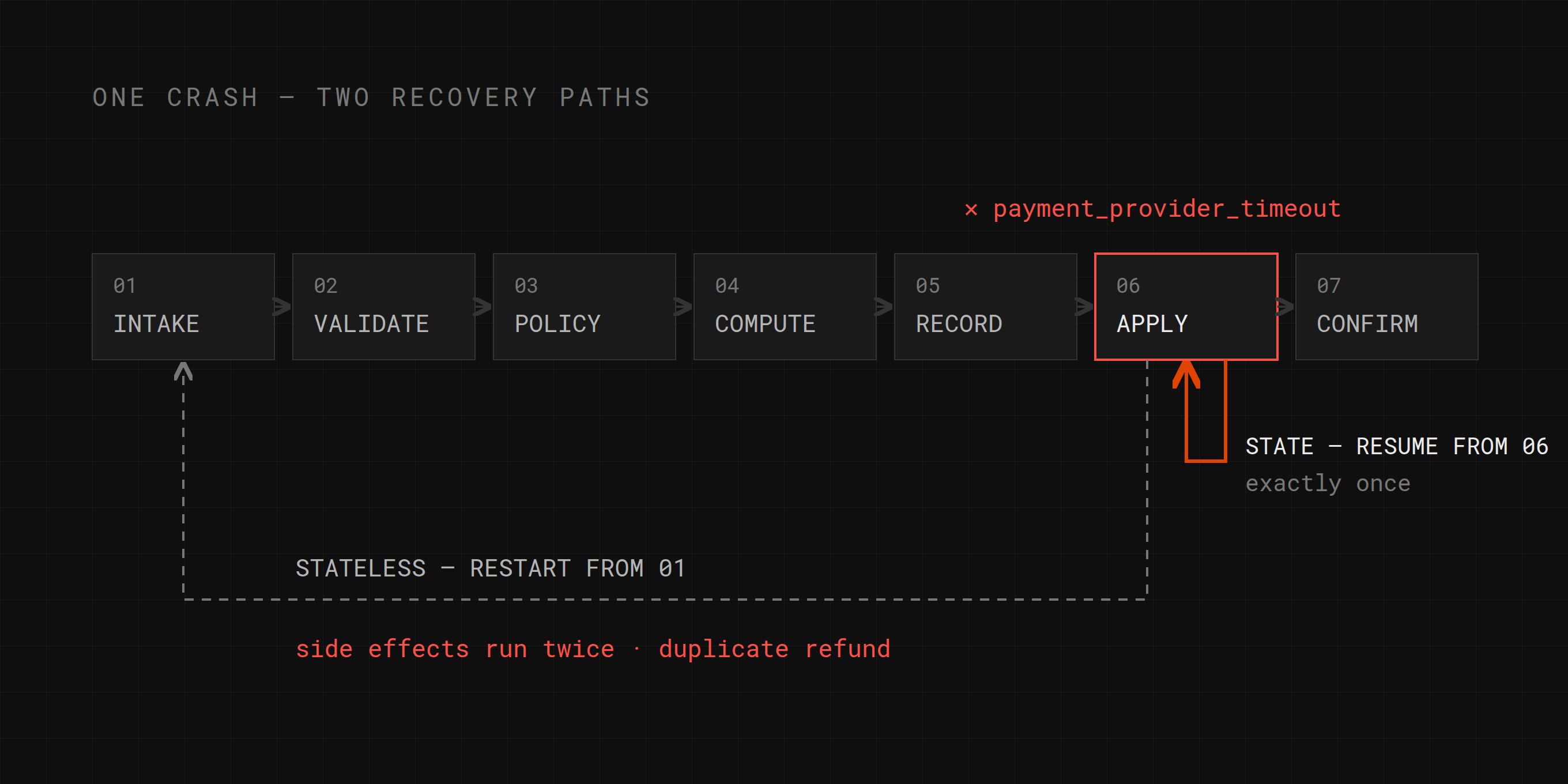
Ramp ran one of the most disciplined agent rollouts in production finance. Across three public sources, there is no evidence the approval workflow survives a crash mid-flight.
Disciplined decisions, unproven durability.
What Ramp Financial Automation Agent Is
Ramp runs production AI agents that automate expense approvals, merchant classification, and policy enforcement for enterprise finance teams. Policy context is assembled from uploaded policy documents, HRIS data, and transaction history. The rollout was graduated: agents shipped as suggestions-only, then customers moved to auto-approval through an autonomy slider that controls which transaction types auto-approve and which route to human review. Roughly 10–15% of expenses escalate to humans; inside Ramp itself, more than 65% of approvals are now fully handled by the policy agent. Multi-step processes are described in natural language as "playbooks" that compile into runnable deterministic workflows. Ramp reports 99% policy-enforcement accuracy and 15x more out-of-policy spend caught versus non-AI alternatives. If you run LLM workflows anywhere near money, this is the reference architecture people will point you at. That is exactly why it earns a teardown.
The STATE Score
| Pillar | Score | One-line verdict |
|---|---|---|
| S — Structured | 1/2 | Stages exist; nothing documents what persists between them |
| T — Traceable | 1/2 | Visibility is rationale summaries, not replayable call traces |
| A — Auditable | 2/2 | Per-decision rationale, documented. The system's best pillar |
| Tol — Tolerant | 0/2 | No checkpoint, resume, idempotency, or lock in any source |
| E — Explicit | 2/2 | Layered gates: slider, escalation, hardcoded restrictions |
| Total | 6/10 |
What Ramp Financial Automation Agent Gets Right
Two pillars score 2/2, and they're earned. The rollout discipline is real: agents shipped suggestions-only, customers graduated to auto-approval through an autonomy slider that controls which transaction types the agent handles alone, and the 10–15% of expenses needing judgment escalate to humans. Ramp tracks a "rate of unsure decisions" metric and hardcodes restrictions that block the agent from high-risk interfaces entirely (per the ZenML and LangChain write-ups). LLM output does not reach a material action without a threshold check or a human in between. That is the E pillar done properly.
And every action ships with a rationale. Ramp's own announcement: "If the agent made the call, you know why and you can trace it back—every time." As a documented per-decision record, that clears the A bar. The gaps below are about what that record is made of, and what's underneath it.
Gap 1: What Happens When an Approval Dies at Step 6?
A system that only works in the forward-motion state is a demo. Production systems fail at step 6 of 10: mid-write, mid-callback, mid-approval.
No public source documents how Ramp's approval workflow handles that. Not the announcement, not the LangChain case study, not the ZenML deep dive. No checkpoint. No resume semantics. No idempotency keys. No locks. The ZenML write-up flags it directly: retry logic, timeout policies, and crash recovery mechanisms aren't described. The public story is high-level reassurance (everything's logged, every decision transparent) with nothing about in-flight failure.
Here is why that matters on this system specifically. Ramp's agents don't just classify; they execute. An expense approval has side effects: the approval record, the ledger consequence, the notification to the requester, the policy log. A timeout between any two of those produces silent partial completion. Either an approval is recorded without its downstream effects, or, if something retries blind, the same action executes twice. On a system that moves money, a duplicate is not a UX bug. It is a reconciliation incident, and finance finds it weeks later.
The suggestions-first rollout makes this gap sharper, not softer. Graduated autonomy validates that the decision was correct. It says nothing about whether the workflow executing the decision survives dying halfway through. Ramp can prove the agent was right and still have no record of what stage the workflow died in.
Score yourself:If your workflow died at step 6 right now, does it resume from step 6, or have you never tested it?
Gap 2: Where Does the Workflow State Actually Live?
Production AI systems fail when they reconstruct business state from conversation history instead of carrying it as an explicit object.
Across the three sources, Ramp's workflow state lives in prompt context. The Tour Guide agent works from an enriched, annotated DOM. The Policy Agent works from uploaded policy documents, HRIS fields, and transaction history assembled into context per decision. Playbooks "compile into runnable deterministic workflows," and the LangChain write-up shows session state updated after each discrete action, so stages exist in some form. But nothing documents what persists between steps: no typed state object, no persisted stage field, no artifact you could read after a crash to know where execution stopped.
That distinction is the whole pillar. Context is ephemeral; state persists. If the decisions live in the conversation, they live nowhere. After a process restart, or under two concurrent runs touching the same transaction, recovery means re-deriving position from event history: replaying what the agent said and did to guess where it was. That is exactly the failure mode explicit state exists to prevent, and it compounds the tolerance gap above. You cannot resume from a stage you never wrote down.
Score yourself:If your agent crashed mid-workflow right now, what happens to the work in progress? Have you tested it?
Gap 3: A Rationale Is Not a Trace
When an LLM system misbehaves in production, the first question is: what exactly did it receive, what did it produce, and when? If you can't answer that after the fact, you're flying blind.
Ramp's observability story is "full visibility into its reasoning and actions." Every decision ships with a generated rationale. That is summary-level visibility, and it has a structural weakness: a rationale is the model's account of its decision, not a record of it. The reasoning can be flawed at the foundation while the output looks clean; the explanation reads fine either way. No source documents the capability that actually settles a post-mortem: pulling the exact rendered prompt, model version, retrieved policy chunks, and tool calls behind one specific historical decision.
The ZenML write-up concedes the point in its own caveat: "teams should assume inputs and outputs are all they can reliably verify." Multi-step processes have intermediary steps, and the intermediary steps are precisely where visibility runs out. They are also where things go wrong.
The consequence surfaces the day the 99% figure drifts. One approval goes wrong, risk asks what happened, and the post-mortem holds a generated explanation of the decision but not the inputs that produced it. The bug cannot be reproduced. Debugging becomes a game of chance.
Score yourself:Could you reconstruct exactly what happened in any specific LLM call from the past 30 days?
What Good Looks Like
None of this requires re-architecting the agents. It requires giving each workflow a body. A typed state object, persisted to a durable store before and after every side-effecting step:
{
  "workflow_id": "appr_01J9XKQ4",
  "stage": "policy_check_complete",
  "stages": ["intake", "policy_check_complete", "approval_recorded", "ledger_written", "requester_notified"],
  "entity_type": "expense_approval",
  "entity_id": "txn_88412",
  "idempotency_key": "txn_88412:approve:v1",
  "trace_ref": "trace_7f3a9c",
  "started_at": "2026-07-05T14:02:11Z",
  "last_updated_at": "2026-07-05T14:02:38Z"
}
With that row in place: resume reads stage instead of replaying history (Tol), the idempotency key turns a blind retry into a no-op instead of a duplicate ledger effect (Tol), and crash position becomes a SELECT, not an investigation (S). Then pin observability to it. Log every LLM call (exact rendered prompt, model version, retrieved policy chunks, tool calls) keyed by workflow_id, and reference the trace from each generated rationale via trace_ref, so every explanation is verifiable against the inputs that produced it (T). The escalation machinery Ramp already built stays exactly as is. This is plumbing, and it is the plumbing that turns a 6/10 into a 9.
The Generalizable Lesson
Graduated autonomy answers one question: does the agent make the right call? Tolerance answers a different one: does the system survive executing it? Ramp built the most rigorous public answer to the first question in production finance and, on public evidence, no answer to the second. Ramp’s own playbook for agentic payments makes the pattern explicit: “Run new models in shadow mode, letting them make decisions alongside your existing process without executing, before granting full autonomy.” Shadow mode is decision validation by construction, and by construction it exercises none of the execution path. The rollout method that builds trust in the agent is structurally incapable of testing the workflow around it. They are separate engineering problems, and the second is invisible in every demo, every accuracy metric, and every suggestions-first rollout. It only surfaces when production kills a process at the worst possible moment. A 99%-accurate decision engine wrapped around an unrecoverable workflow is still an unrecoverable workflow. State beats intelligence: the model made the right call; the plumbing decides whether that call lands exactly once.
FAQ
Does Ramp's AI agent log its decisions?
Yes, at the rationale level. Every agent action ships with a generated explanation, and Ramp's announcement claims per-action traceability. What no public source documents is call-level trace replay (the exact prompt, model version, and tool calls behind one specific historical decision), which is what a post-mortem actually needs.
Is Ramp's approach safe for regulated financial data?
The control surface is strong: graduated autonomy, human escalation for material transactions, and hardcoded restrictions on high-risk interfaces. But a regulated deployment must answer "what data drove this specific decision" with records rather than generated narratives, and must document crash-recovery semantics on any workflow that posts financial effects. On public evidence, both remain open.
Does a suggestions-first rollout make an agent production-ready?
Suggestion mode ships the agent's calls as recommendations a human confirms, and graduates the agent to autonomy as confidence builds; that is the rollout Ramp describes. It is the right way to validate decision quality. It validates nothing about execution durability (checkpointing, resume, idempotency), which is a separate readiness gate that this pattern quietly skips. Before wiring an agent to real side effects, score the whole system, not just the model.
I run this scoring against your interior evidence.
Logs, schemas, incidents — the same STATE scoring applied to your production system, with a findings memo ranked by production risk.
See the founding program →